Your Shoe Size Is a Lie
by Slava Gu on Thu May 07 2026
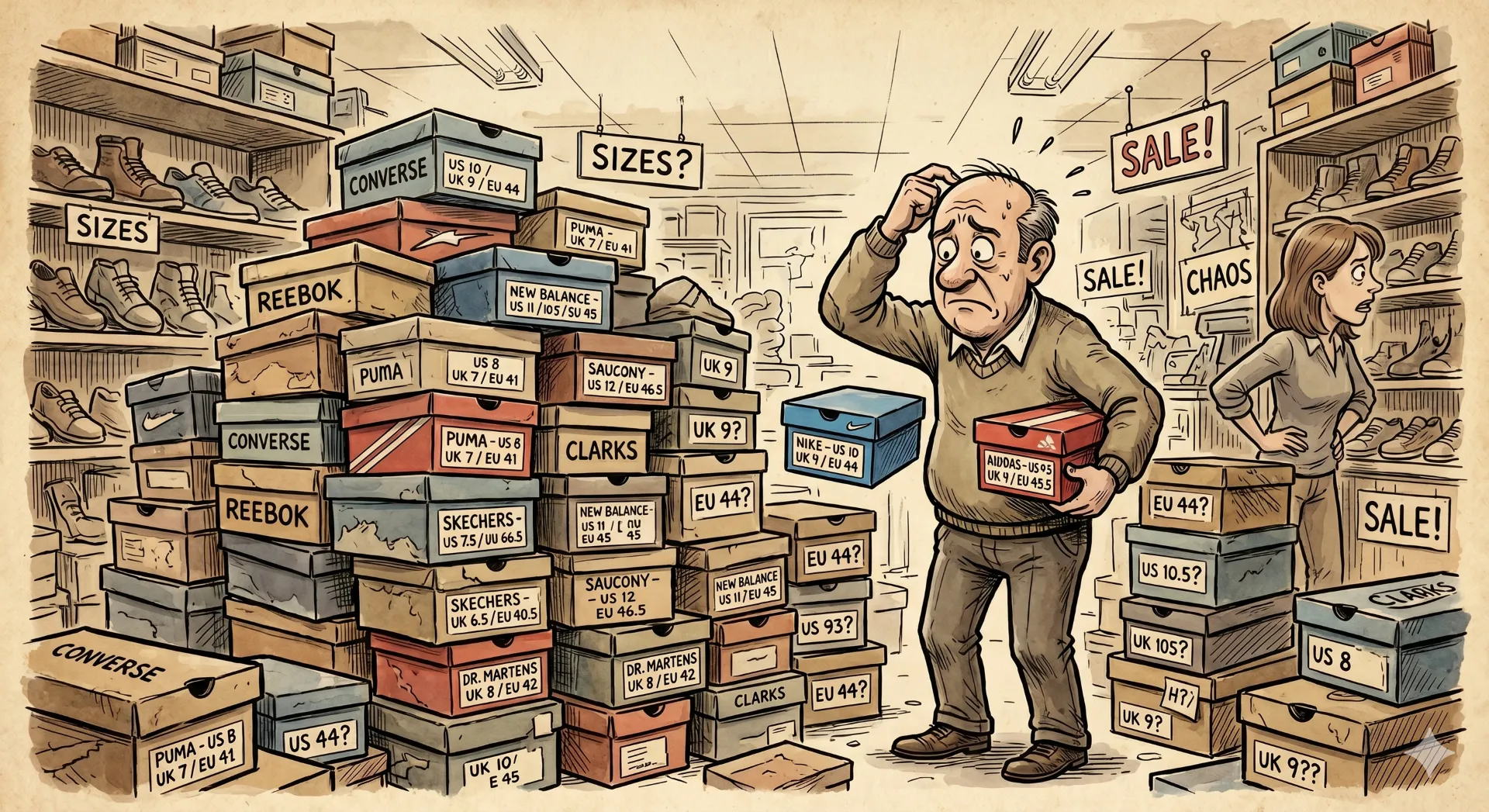
We live in an age of precision. We can track a satellite in orbit to within centimetres, sequence a human genome, and split an atom. And yet. Walk into a shoe store, and you are teleported back to medieval England.
We are still measuring human feet using barleycorns. A unit defined by King Edward II in 1324 as the length of three dried grains of barley. Barley has since been replaced as a unit of measurement everywhere on Earth. Except here.
The result is 700 years of total confusion. US, UK, EU, and AU sizing standards that don’t agree with each other, paired with a cheerful industry shrug that says “just try it on and see.” This isn’t just inconvenient. It is a quiet, persistent failure of empathy toward the people whose feet actually go inside these things.
The Mythology of “Runs Narrow”
We’ve all heard the folklore. “This brand runs small.” “Just go up half a size.”
This is nonsense. If a manufacturer makes a shoe that is narrower than the standard, they haven’t made a “narrow size 10.” They’ve made a shoe with specific internal dimensions that they are politely declining to tell you about. That’s not a sizing quirk. That’s withholding product information and dressing it up as folk wisdom.
Consider tyres. When you buy rubber for your car, you need three numbers: width, aspect ratio, diameter. Something like 225/45/R17. You know 100% whether they fit. Nobody drives to the garage and nervously asks the mechanic whether Michelins “run narrow.” The numbers mean what they say.
We standardised the rubber keeping our cars on the road decades ago. The leather and foam keeping humans on their feet deserves the same rigour.
One Body Part, One System
A foot is a physical object with measurable dimensions. A 260mm foot is a 260mm foot. It doesn’t have a gender.
A universal millimetre-based system of Length x Width x Rise for shoe sizes would fix several things at once:
- Dramatically fewer returns. And far less landfill. Between 30-40% of online shoe purchases get sent back because of fit. Most people don’t realise that a significant portion of those returned shoes never get resold. Checking, cleaning, and repackaging costs more than discarding, so that’s exactly what happens. Your “returned” trainers quietly end up in landfill. A measurement system that actually works would be an environmental policy in disguise.
- An end to the children’s size labyrinth. “Toddler” to “Little Kid” to “Big Kid” to suddenly adult sizes is a gauntlet no parent should have to run on a Sunday afternoon.
- True gender neutrality. The numerical offset between men’s and women’s scales is a legacy of mid-century retail convention. It serves no purpose. It can go.
Who Gets Hurt Most
People with wide feet, high arches, or asymmetric sizing navigate a market that was not built for them. They pay more, return more, and often settle for shoes that are actively bad for their feet. The current system doesn’t just inconvenience them. It fails them structurally.
And there is a genuine health argument here. Ill-fitting footwear causes real physical harm over time. Blisters, bunions, postural problems. A proper sizing standard is, quietly, a public health measure.
So Who Moves First?
The major manufacturers have enormous incentives to keep the current system. Confusion benefits those with the strongest brand recognition. If nobody can be sure a shoe will fit, they buy the brand they’ve trusted before. Standardised sizing is, paradoxically, a competitive threat to the dominant players.
Meaningful change is more likely to come from a challenger. One ambitious brand releasing a transparent “millimetre collection” would immediately signal to every frustrated online shopper that a better way exists.
And if the industry won’t move? Then governments should step in. We already mandate:
- Calorie counts on food packaging
- Fuel consumption ratings on cars
- Energy efficiency labels on electrical goods
Shoe sizing is no different. Mandating that manufacturers disclose internal dimensions in millimetres is a modest regulatory ask with an outsized benefit to consumers, the environment, and the logistics industry.
King Edward II issued his barleycorn decree as law. Perhaps it takes another decree to finally replace it.